


3D Printed Letters and Logos: When They Make Sense in Visual Communication
How 3D printed letters and logos work, which materials to use, how large they can be and when 3D printing is the right choice.
3D printing has moved out of the lab and into visual communication. For letters, logos and brand identity pieces, it handles shapes that would be expensive or impossible to produce from cut sheets, and it does so without a mold, which makes a single piece viable.
It does not replace everything, though. Knowing where 3D printing pays off, and where acrylic, ACM or MDF are still the better option, avoids paying more for a result another technique would deliver better.
How filament 3D printing works
In filament printing (also known as FDM), a plastic filament is heated and deposited layer by layer until the part is formed. The starting point is a 3D file, which can be created from the brand's vector logo.
Because each layer sits on top of the previous one, the printed surface shows fine lines. On pieces seen up close, such as reception letters, these lines are usually treated with sanding, filler and paint, a step that makes a big difference to the final result.
PLA, PETG or ABS: which material to choose
PLA is the easiest material to print, with good detail accuracy and a good finish. On the other hand, it softens with heat and degrades in direct sunlight, so it is best suited to indoor use.
PETG is more resistant to impact and moisture and handles somewhat higher temperatures than PLA. It is a good choice for humid areas or covered spaces with temperature changes.
ABS has higher heat resistance and takes sanding and painting very well, which makes it a good fit for parts that will receive an elaborate finish.
For pieces outdoors, exposed to sun and rain, the material should be chosen together with the paint and the mounting system, and is worth evaluating case by case.
When 3D printing is the best choice for letters and logos
3D printing stands out when a logo has volumes, curves, bevels or relief that a cut sheet cannot reproduce; when the quantity is small and a mold is not worth it; and when the piece must faithfully reproduce a three-dimensional element of the brand.
For flat letters of uniform thickness in large quantities, cutting acrylic, ACM or MDF is usually faster and more economical. For LED-lit channel letters, acrylic remains the reference material because of the way it diffuses light.
In practice, many projects combine techniques: the base or background in cut sheet and the highlight element of the logo in 3D printing.
What if the piece is larger than the printer?
Every 3D printer has a maximum build volume. At Momentvm Opvs, each part can be up to 40 × 40 × 40 cm. Beyond that, the model is split into sections in the file itself, printed in segments and then joined.
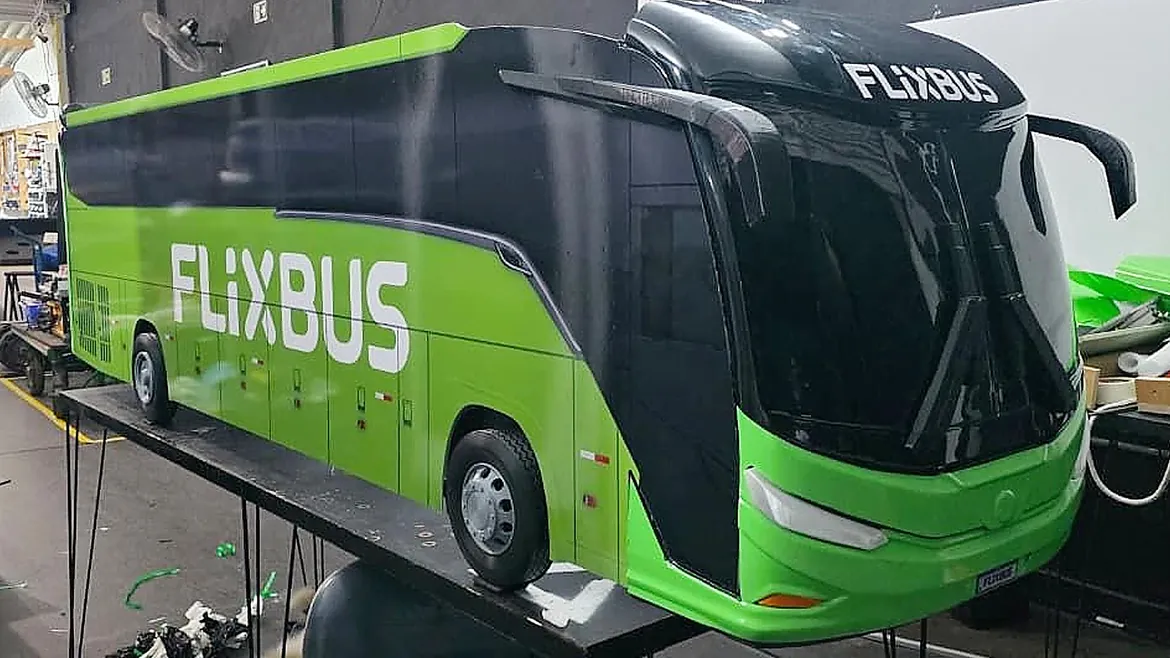
That was the case with the large-scale bus model shown at the top of this article: the sections were printed separately, joined and finished with paint until the seams disappeared. The same process applies to large letters, totems and set pieces.
What to send when requesting a quote
To evaluate a 3D printed letters or logo project, it helps to send:
- the logo as a vector file (AI, SVG, PDF or EPS) or a ready 3D model (STL, OBJ or STEP);
- the desired dimensions and the thickness (depth) of the letters;
- the installation location: indoors, covered area or outdoors;
- the expected finish: the material's own color or paint;
- the mounting method: wall, panel, glass or a dedicated base.
Besides letters and logos, scale models, prototypes and custom parts can be evaluated from a file or a reference of what is needed.
Momentvm Opvs — Visual Communication and Decoration
30 years of professional experience.
São Paulo — Brazil
You imagine it, we make it real.
About this content: this article is part of the content restructuring of the Momentvm Opvs website, carried out with technical SEO and GEO consulting by Underneath – Search Intelligence.
